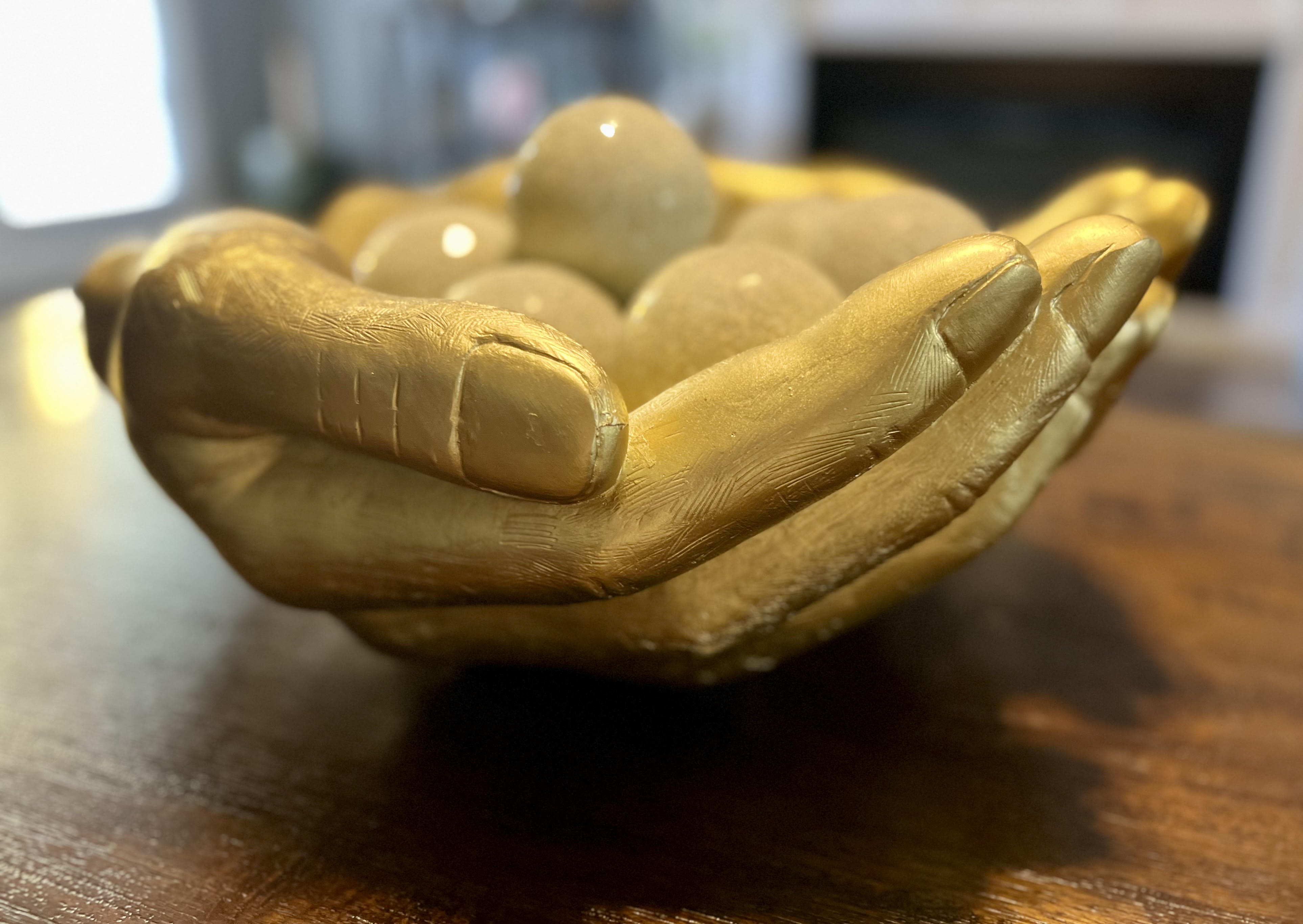
On the coffee table in my living room sits what I jokingly refer to as one of the most debated pieces of art in history. That may be a bit of an exaggeration, but it has certainly sparked more conversation than I ever expected.
The centerpiece is a sculpture of two cupped hands, palms facing upward, forming a bowl. Resting inside is a collection of white and glass mosaic spheres—small, shimmering orbs that resemble snowballs catching the light. Are they extended outward, offering their contents to someone else? Or are they lifted upward, ready to receive a gift? I've heard compelling arguments for both interpretations. My favorite response, however, is a question: Why can't they be both?
That simple question reminds me of a concept from Crucial Conversations: Tools for Talking When the Stakes Are High. The authors describe what they call "The Fool's Choice"—our tendency to believe we must choose between two competing options when, in reality, a better answer often exists beyond either/or thinking. Rather than settling for one perspective over another, they encourage us to search for what they call the elusive "and." Instead of asking which choice is right, we ask questions that help us discover how both ideas might coexist. That lesson extends well beyond difficult conversations. It also describes the work of leadership.
As mathematics leaders, we naturally spend much of our time in the world of giving. We give our expertise, our encouragement, our time, our energy, and often a little more of ourselves than anyone else realizes. We coach, mentor, advocate, troubleshoot, celebrate, and support. Giving is woven into our professional identity. But what if leadership isn't only about giving? What if exceptional leadership also requires us to become intentional receivers?
As summer begins to give way to another school year and we prepare to re-enter our (formal) realms of reasoning, I hope we don't spend all of our energy thinking about what others will need from us. Instead, I hope we also consider what we need to receive. The strongest leaders I know aren't simply generous; they are humble enough to recognize that they, too, need opportunities to grow, to pause, and to be supported.
Here are a few things I hope to "take" this year.
My time.
Not just time to accomplish tasks, but the time to accomplish them to the best of my ability. Time to wrestle with new ideas. Time to sit comfortably in the learner's seat, especially when uncertainty reminds me that growth rarely feels effortless. I'll also take time to rest, to refocus, to reset, and to realign whenever needed. Rather than allowing time to simply pass, I want to intentionally take advantage of it.
Good guidance from good people.
One of the greatest gifts of mathematics—and of life—is that none of us has to figure everything out alone. Some of the most valuable lessons arrive through intentional mentoring; others appear unexpectedly in hallway conversations, conference sessions, or casual phone calls. I continue to be grateful for the people who generously share their wisdom with me. Case in point: years ago, Past President Mona Toncheff recommended Crucial Conversations to me. A single book recommendation became a lesson that continues to shape how I think about leadership today.
Perhaps that's the beauty of those hands on my coffee table. Maybe they aren't choosing between giving and receiving at all. Maybe they're reminding us that meaningful leadership requires both. As you prepare for the months ahead, I invite you to make two lists. What will you intentionally give this year? And just as importantly, what will you intentionally receive?
If you'd be willing, I'd love to hear your reflections. Email me at [email protected] and share something from your lists. With your permission, I'd enjoy highlighting some of your ideas in future Insider messages so we can continue learning from—and encouraging—one another. Giving and taking.